The Trap
The Venn Diagram of Corruption 🔒
If you watch the news, you are told that Washington is paralyzed by polarization. Democrats and Republicans allegedly cannot agree on the color of the sky.
Yet, miraculously, they always seem to agree on healthcare bills that do absolutely nothing to lower your premiums.
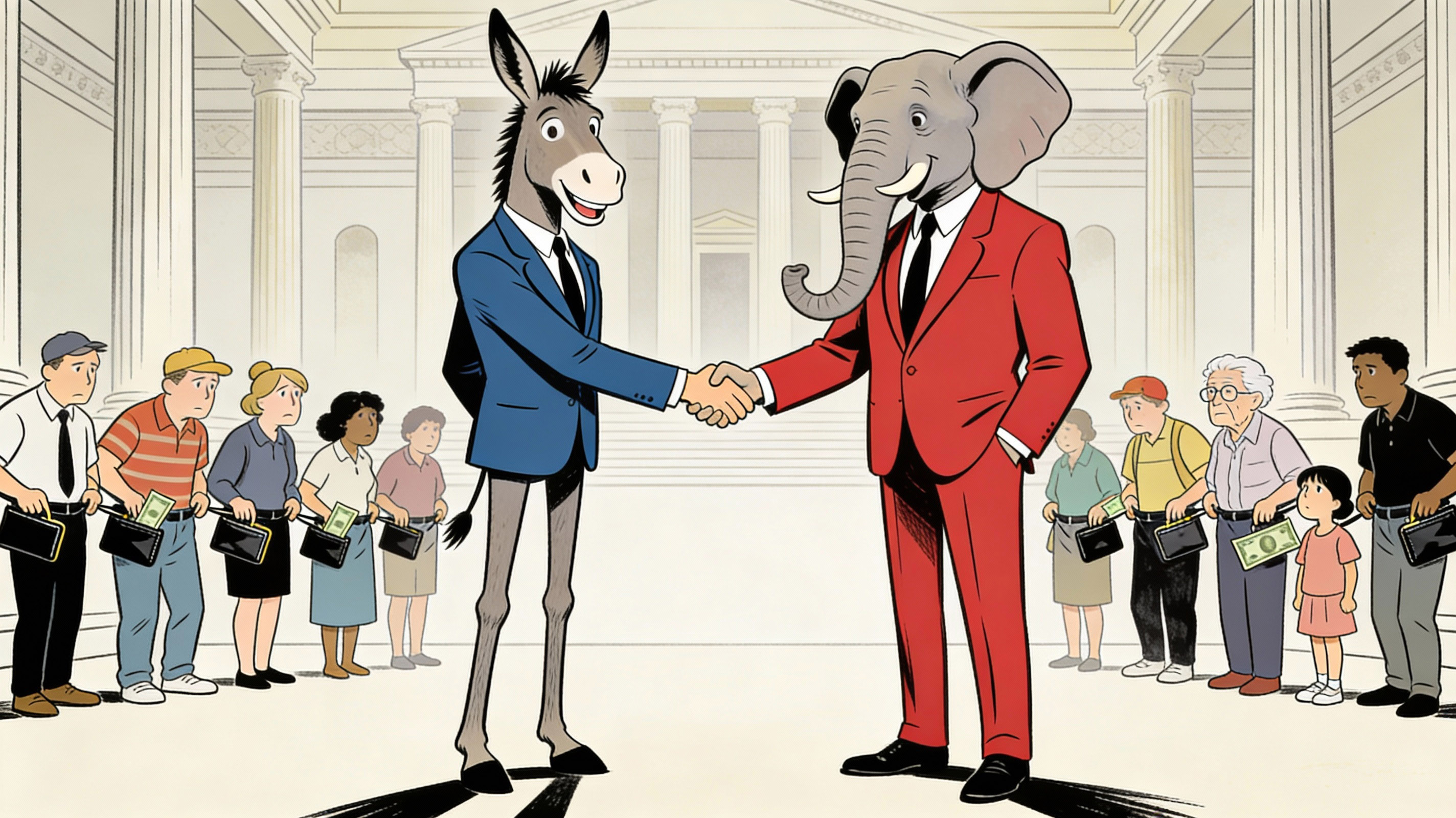
This is the "Bipartisan Trap."
In the real world, bipartisanship is good. In the swamp, it is a code word for a deal that satisfies the lobbyists of both parties. Here is how the sausage is made:
- The Blue Team's Donors: Health Insurance companies and Hospital Systems (who want subsidies and mandates).
- The Red Team's Donors: Big Pharma and Medical Device makers (who want patent protection and deregulation).
When they write a "Bipartisan Healthcare Bill," they don't fight. They trade. The Democrats get a subsidy that funnels tax dollars to insurers. The Republicans get a patent extension that keeps generics off the market. They shake hands, call it "The Affordable Access and Innovation Act," and your deductible goes up by $500.
The Revolving Door Why do they do this Because they are auditioning. A 2023 study found that 32% of officials appointed to the Department of Health and Human Services (HHS) leave their government jobs to work for the industry they just regulated. They aren't regulating the companies; they are fluffing their pillows.
The Trap: When you hear "Bipartisan Compromise," check your wallet. It usually means the industry got everything it wanted, and you got a brochure about "wellness."
The Fix
The SAFEC+ Solution: Scorched Earth ✅
SAFEC+ is not bipartisan. It is anti-parasite.
We did not ask the insurance lobby for their input. We did not ask Pharma what "rate of return" they find acceptable. We wrote a bill that prioritizes the biological survival of the citizen over the quarterly earnings of the shareholder.
1. No Negotiation with the Middleman (Section 1004) Most bills try to "regulate" insurers. We sunset them. Section 1004 prohibits private entities from selling the essential benefit floor. You cannot bribe a politician to weaken a regulation on an industry that no longer exists.
2. The Price is The Price (Section 405) We do not create a "bipartisan committee" to study drug prices. Section 405 mandates Most-Favored-Nation Pricing. If France pays $50 for insulin, we pay $50. There is no wiggle room for a lobbyist to insert a loophole.
3. Felony Penalties (Section 803) Typically, when a healthcare company defrauds the government, they pay a fine—a cost of doing business. SAFEC+ makes systemic fraud a Federal Felony with mandatory prison time. It turns out, CEOs are much less willing to break the law when the penalty is a cage, not a check.
SAFEC+ restores the proper order: The government fears the voters, and the corporations fear the law.
The Critics
"Gridlock Will Kill It"
Critics say a partisan bill can never pass the Senate filibuster.
The current "bipartisan" strategy has failed for 40 years. Every major social advancement—from Social Security to Medicare—was initially called "radical" and fought tooth and nail. You do not break a deadlock by asking the opposition for permission; you break it by winning a mandate.
"The Pendulum Swing"
If we pass this on a party-line vote, the other party will repeal it as soon as they win.
History shows otherwise. Once a benefit is delivered—once people have free healthcare—taking it away is political suicide. Republicans spent 10 years promising to repeal the ACA, and when they finally had the power in 2017, they choked. Why Because you cannot take medicine away from a sick voter and expect to survive the next election.
The Lobbying Tsunami
The industry will spend billions to kill this. They will run ads claiming SAFEC+ causes cancer in puppies.
The Mitigation: We cannot out-spend them. We can only out-vote them. The bill relies on the fact that for every 1 lobbyist, there are 10,000 victims of the current system.