
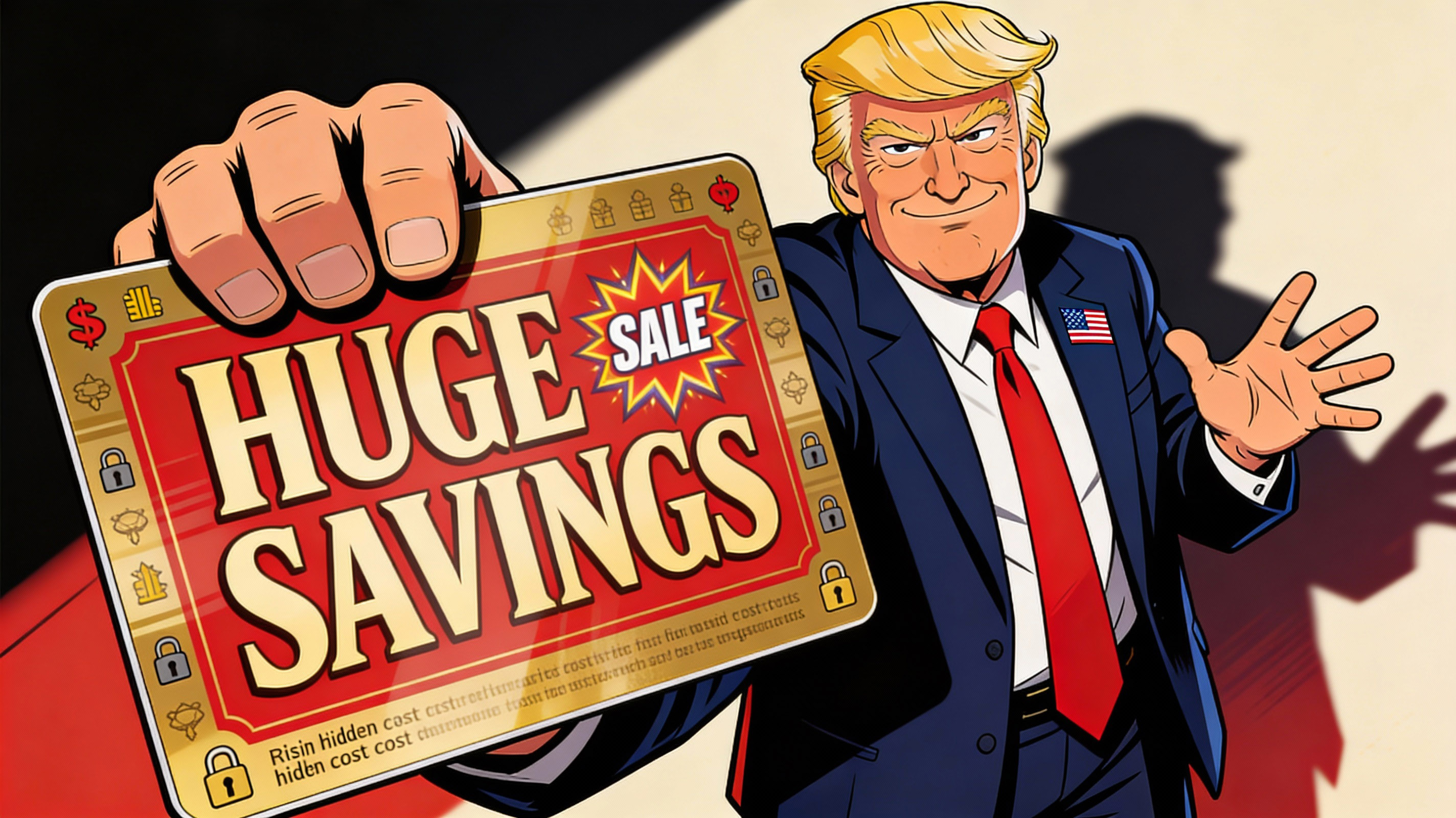
The Trap
The Arsonist with a Fire Extinguisher 🔒
If a man burns your house down, and then offers you a 10% off coupon for a tent, he is not a hero. He is an arsonist with a loyalty program.
This is the reality of the "Discount Card" economy. Politicians love them because they look like solutions. They are not solutions. They are permission slips to be gouged slightly less.
Here is how the hustle works:
- The Fake Price: Pharma companies set a "List Price" that is completely imaginary. Let’s say $1,000 for a drug that costs $10 to make.
- The Panic: You go to the pharmacy. You see the $1,000 price. You panic.
- The Savior: An app on your phone says, "Don't worry! Use this Gold Card and pay only $200!"
- The Trick: You feel grateful for saving $800. You forget that you just paid $200 for a $10 pill.
The Data Trap 🗑️ These cards are not charities. They are for-profit data vacuums. When you use a discount card, you are often handing over your HIPAA privacy rights. The card company tracks what diseases you have and sells that profile to advertisers. You are paying for the discount with your medical history.
The PBM Kickback 🪙 Most discount cards are actually run by the same Pharmacy Benefit Managers (PBMs) that jacked up the price in the first place. They collect a transaction fee every time you use the card. They need the list price to be high so that their discount looks big. If the price was fair ($10), their business model would evaporate.
The Trap: A coupon normalizes the abuse. It teaches you to be thankful for a slightly lighter beating.
The Fix
The SAFEC+ Solution: The End of the Coupon Era ✅
SAFEC+ does not offer you a coupon. It offers you the law.
1. National Formulary Real Prices (Section 405) Under Section 405, the SAFEC+ Plan establishes a National Formulary with a simple rule: Most-Favored-Nation Pricing.
2. The International Ceiling SAFEC+ mandates that the price we pay cannot exceed the International Reference Price (Section 405(c)). If the exact same drug is sold in France or Japan for $15, then the price in the United States is $15.
3. No "List Price" Games We do not negotiate off the fake "List Price." We pay the "Negotiated Net Price" (Section 405(b)). This eliminates the gap where discount cards live. When the price is $15 for everyone, you don't need an app to find a "deal."
4. Data Privacy (Section 804) By moving coverage to the SAFEC+ Plan, your health data is protected by federal privacy laws that strictly prohibit its use for advertising or non-health purposes. We treat your medical history as a record, not a commodity.
We don't want a discount on theft. We want the theft to stop.
The Critics
"You Are Killing Innovation"
Pharma lobbyists claim that without high prices (and the coupons that support them), they cannot invent new cures.
Drug companies spend more on stock buybacks and marketing than they do on R&D. Furthermore, Section 407 (Small Innovator Support) creates a dedicated fund to help actual scientists (startups) get FDA approval without selling out to Big Pharma. We fund the science, not the marketing department.
"Immediate Disruption"
Millions of people rely on GoodRx and similar cards right now to survive. Banning the need for them takes time to implement.
The Mitigation: The transition is phased. During the implementation period (Years 1-3), existing programs remain. But as Section 1005 rolls out universal coverage, the need for these cards naturally hits zero. You don't need a coupon for the Fire Department, and you won't need one for Insulin.
The Data Industry
Companies like GoodRx are publicly traded and employ thousands of people. SAFEC+ essentially destroys their business model.
Yes. It does. A business model based on arbitrage and data surveillance of sick people is not a business model worth saving. The economy will adapt; the patients cannot wait.