
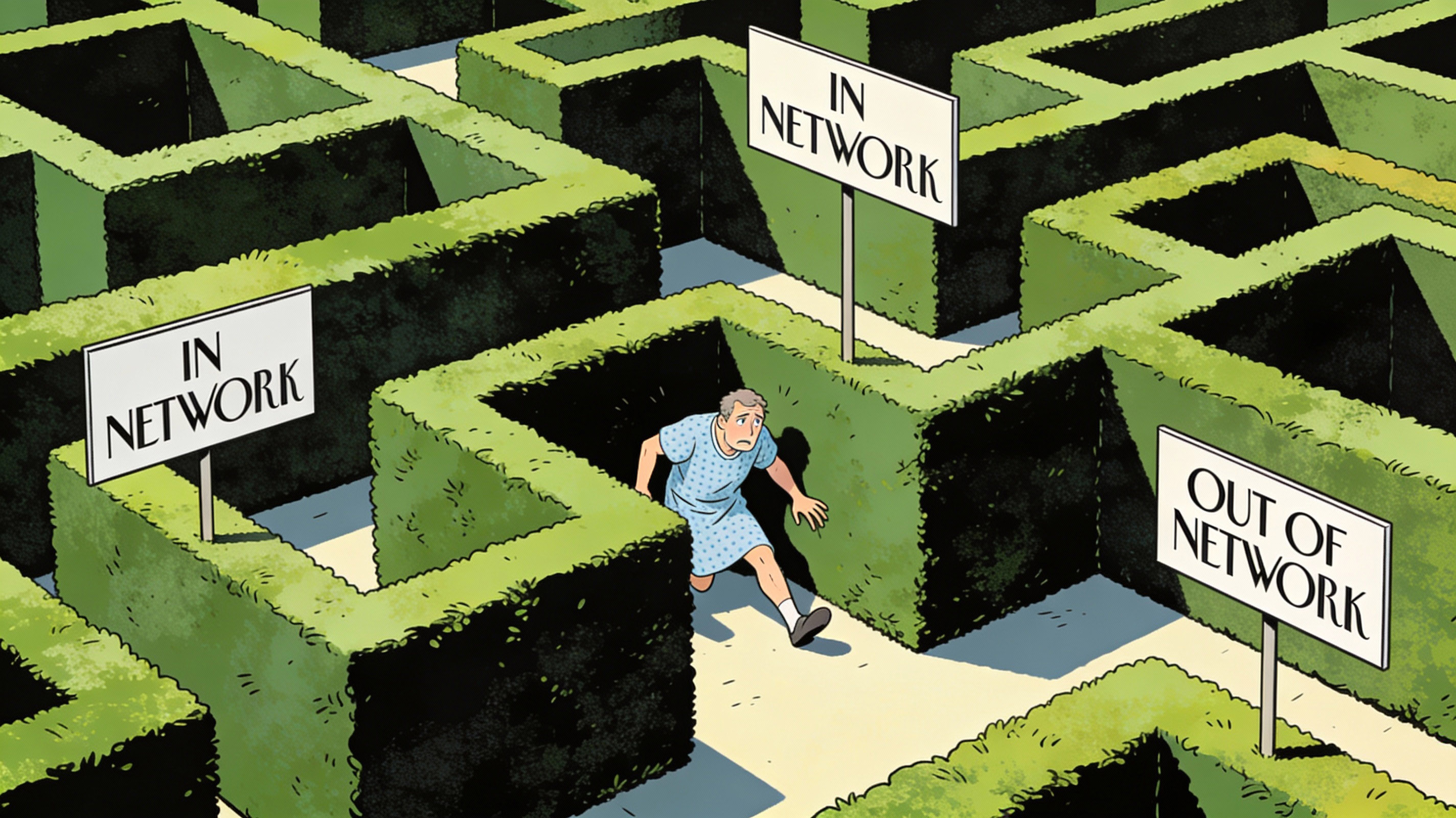
The Trap
The Invisible Fence 🔒
In America, your insurance card is not a payment method; it is a restraining order. It tells you exactly who you are not allowed to see.
They call it a "Provider Network." They tell you it exists to ensure quality. This is a lie. The "Network" exists for one reason: Leverage.
Insurers use the threat of exclusion to force hospitals to lower their prices. Hospitals use the threat of leaving the network to force insurers to pay more. You are the hostage in this negotiation. If you get sick in the wrong zip code, or if your ambulance drives to the wrong building, you are "Out-of-Network," and your bankruptcy begins.
The "Ghost Network" Fraud 👻
It gets worse. Even when you follow the rules, the game is rigged. Insurers maintain "Ghost Networks"—directories full of doctors who are retired, dead, or simply not accepting patients.
- A Senate Finance Committee investigation found that 80% of listed mental health providers were unreachable or not accepting new patients.
- A New York Attorney General audit found 86% of listed providers were "ghosts."
They sell you a policy claiming you have access to 10,000 doctors. In reality, you have access to a voicemail box full of rejections. They are selling you a map to a city that doesn't exist.
The Trap: The "Network" forces you to choose between your health and your wallet. If you need a specialist who isn't on the list, you pay cash or you suffer. That isn't insurance; that is a discount coupon with blackout dates.
The Fix
The SAFEC+ Solution: The United States is the Network ✅
SAFEC+ does not expand the network. It abolishes the fence.
1. Universal Participation (Section 401) Under Section 401, any provider who wishes to be paid by the Plan must sign a participation agreement. Because the Plan covers nearly every American (Universal Entitlement, Section 103), no provider can afford to opt out. If they want to practice medicine in the US, they accept the Plan.
2. No "Out-of-Network" Penalties Because there is only one payer with one set of rates (Section 402), there is no such thing as "Out-of-Network." You do not need to check a directory before you call an ambulance. You do not need to worry if the anesthesiologist is in a different network than the surgeon. If the provider is licensed, you are covered.
3. Portable Coverage (Section 304) Your coverage is tied to you, not your job or your state. Section 304 guarantees that your membership remains in force whether you move from New York to Texas, quit your job, or start a business. The "Job Lock" that keeps people in miserable employment just to keep their "in-network" doctors is broken forever.
4. Killing the Ghost We don't need accurate directories of "who is covered" because everyone is covered. The administrative waste of maintaining, verifying, and fighting over network lists (which costs billions annually) vanishes.
The Critics
"You Will Lose Your Choice"
Opponents will claim that a government plan limits your choice of doctors.
Look at your current plan. That is limited choice. You are restricted to a specific list of corporate-approved vendors. Under SAFEC+, you have absolute choice. You can see any doctor, anywhere in the country. The only "choice" we are removing is the insurance company's choice to deny you access.
"The Mayo Clinic Problem"
Critics argue that without networks to steer traffic, everyone will fly to the best hospitals (like Mayo or Cleveland Clinic) for a common cold, overwhelming them.
This is solved by Triage, not money. Top-tier specialists will prioritize complex cases based on medical necessity (referrals), just as they do now. The difference is that currently, they prioritize complex cases with good insurance. Under SAFEC+, admission to a top facility is based on the severity of your tumor, not the size of your bank account.
Provider Resistance
Some high-end concierge doctors who currently take only cash may refuse to join the Plan, creating a small tier of "luxury medicine" for the ultra-rich.
The Mitigation: Section 401(c) prohibits excess charges for essential services. While doctors can opt out completely and take cash, they cannot take the Plan and charge extra. Most providers cannot survive on the 1% of the population willing to pay 100% cash, so the vast majority will join the system.