
The Trap
The Fairy Tale of the 'Nice Company' 🔒
Let us grow up.
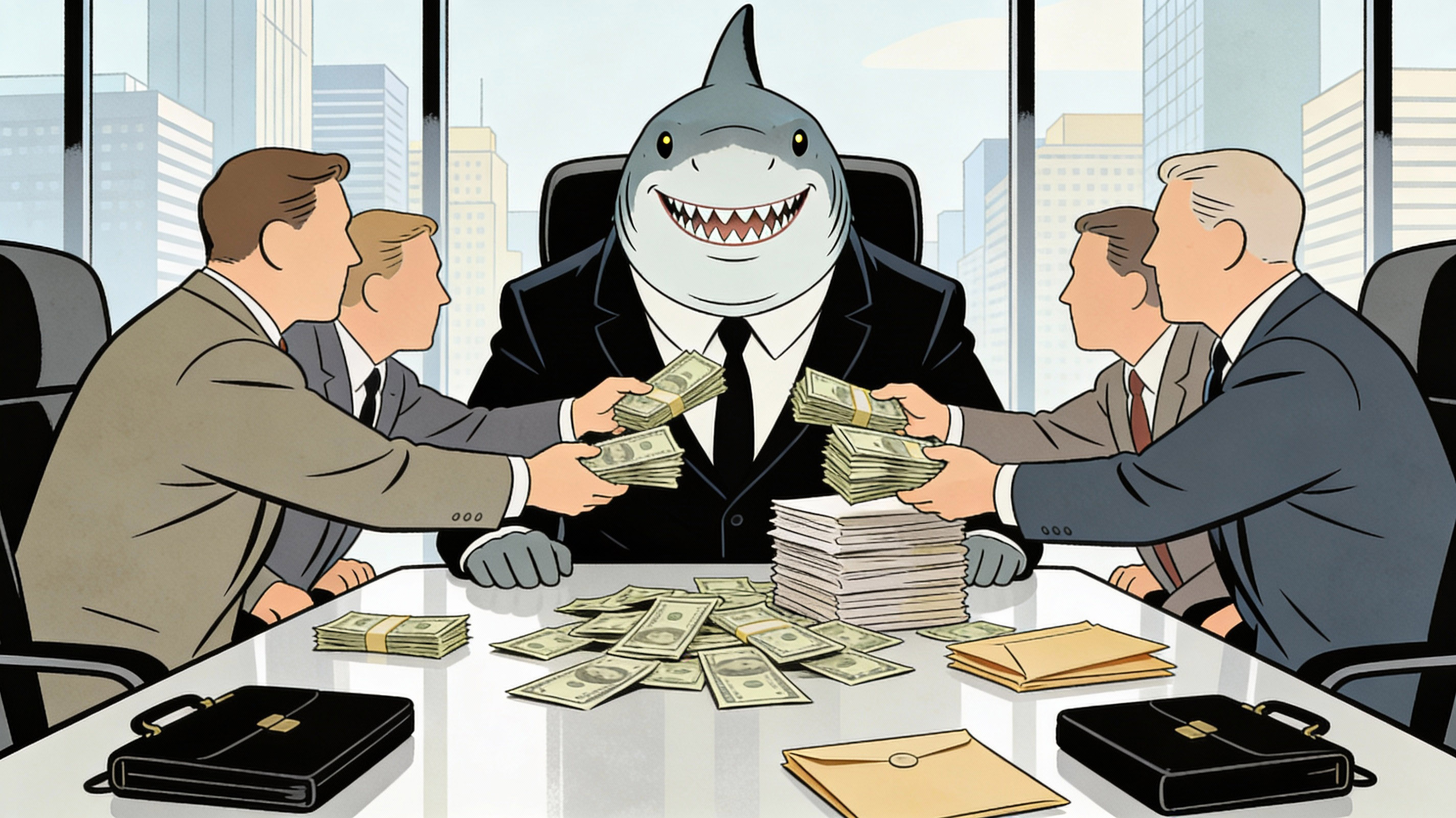
There is a pervasive, elementary-school notion in American discourse that pharmaceutical companies and insurers are "evil" because they put profits over people. This is not just wrong. It is boring. It is like being angry at a Great White Shark for eating a seal. The shark is not evil. The shark is hungry. That is its nature.
Business 101: A corporation is a machine built for exactly one purpose: To maximize returns for shareholders.
That is not a conspiracy. It is a fiduciary duty. The CEO of Pfizer or UnitedHealth has a legal obligation to extract as much money from the market as the law allows. If they leave money on the table out of "kindness," they can be sued by their investors.
And who are these investors They are not just men in top hats smoking cigars. They are the pension funds of teachers. They are the index funds in your grandmother's 401(k). If you want your retirement fund to go up, you are implicitly asking these CEOs to be ruthless.
The Rational Monopolist: In reality, the goal of every competent business is to become a monopoly. To crush competition, raise prices, and capture the market. This is completely rational. Anyone who tells you they started a business to "share the market" is either a liar or a bad businessman.
The Real Scam: The scam is not that companies are greedy. The scam is that your Senators and Representatives pretend to be shocked by it.
When a CEO raises the price of insulin to $600, they are doing their job. When a Senator writes a law that allows them to do it, the Senator is failing theirs.
The Trap: Focusing on the "morality" of a CEO is a distraction. An openly greedy company is not a failure of capitalism. It is a failure of legislation.
The Fix
The SAFEC+ Solution: Change the Physics ✅
Do not ask the shark to go vegan. Change the cage.
SAFEC+ assumes corporations will pursue profit and designs the system so profit comes from efficiency and compliance, not from extracting rent through loopholes.
1. Rule alignment beats moral speeches
The system sets what counts as essential coverage, what can be billed, and what is prohibited. When the rules are tight, "maximize profit" points toward doing the allowed thing efficiently.
2. Certified plans are constrained (Section 105)
Plans that want to cover the essential tier must meet certification and regulated utility requirements. They can compete, but not by excluding coverage, inventing traps, or turning denial into revenue.
3. Claims and oversight become centralized enough to see the whole picture (Section 801)
A national claims data platform and clearinghouse makes it harder to hide fraud, kickbacks, and shell games behind fragmented silos.
4. Penalties that sting (Section 803)
When the penalty for systemic fraud is a fine that fits inside a bonus, it is not a penalty. SAFEC+ moves serious, repeat behavior into felony territory and makes enforcement measurable.
The point is simple. Greed is stable. Laws are optional. SAFEC+ makes the laws harder to dodge.
The Critics
"Corporations Have a Social Responsibility"
PR departments spend billions convincing you that their company "cares," and investment giants push "Social Scores" (ESG) to enforce it.
A corporation does not have feelings. It has a balance sheet. "Social Responsibility" is a marketing budget line item used to prevent regulation. We watched movie studios burn billions producing "socially responsible" lectures that nobody watched. We saw tech companies remove chargers from phone boxes to "save the planet" (while keeping the price the same). It is not morality. It is cynicism wrapped in a slogan. Consumers despise it because they know that the same company lecturing them on virtue is using slave labor in their supply chain. The solution is not a better mission statement. It is a tighter law.
"Stifling Innovation"
Critics argue that strict regulations will kill the "animal spirits" of the market.
The current market is not "spirited". It is rigged. In theory, monopolies have the infinite funds needed for risky R&D. In practice, they are paralyzed by boards that demand steady "maintenance revenue" over unpredictable research losses. Look at the tech giants: Apple and Google locked down their monopolies and immediately stopped innovating. Apple sells us the same phone with a slightly different camera bump every September, while Google forces us to use the same RAM-eating browser that tracks our every pulse. Monopolies stifle innovation because stasis is safer than progress. By breaking the "regulatory capture," we force them to actually compete on value, not just extract rent from a captive audience.
The Lobbying Hydra
Even if we pass good laws, companies will immediately hire lobbyists to drill new loopholes. But let us be clear: Lobbyists are not the problem either. They are mercenaries doing their job. Their strength is only proportionate to the weakness of our Senators and Representatives.
The Mitigation: Regulation is active maintenance. However, by simplifying the system (Single Payer for essential care), we reduce the number of moving parts where lobbyists can hide. Complexity is the lobbyist's best friend. It is the nucleus of corruption. Look at our tax code: only straightforward W-2 payroll workers are targeted for ransom, because they cannot hide. Meanwhile, the wealthy use the complexity (depreciation, offshores, and shells) to camouflage their wealth and pay zero. The complexity is the loophole. SAFEC+ is designed to be brutally simple.