
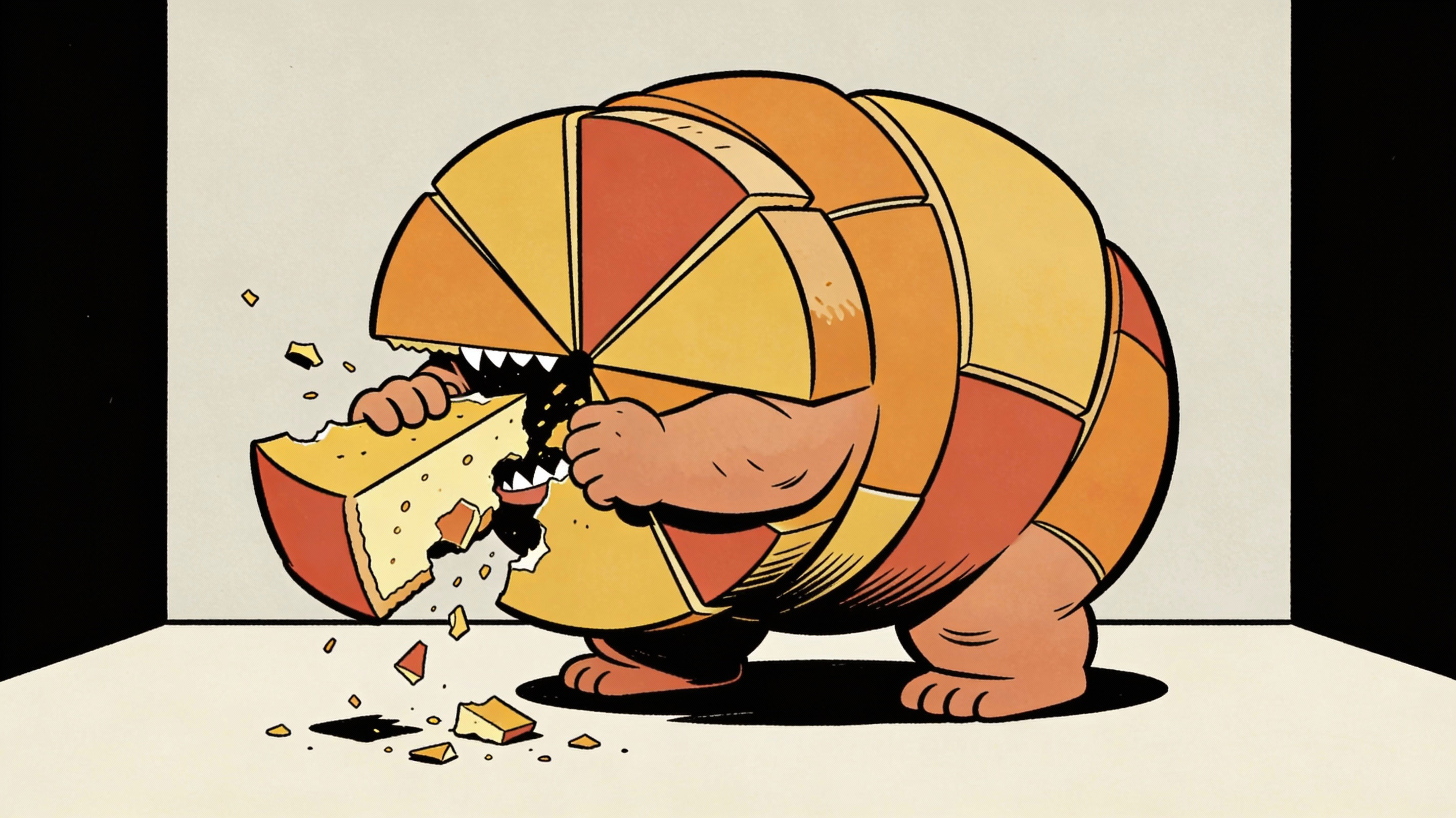
The Trap
The 80/20 Rule: A License to Steal 🔒
Let us begin with a definition, because the insurance industry relies on the fact that you have a job and a life, and therefore do not have time to read federal registers. They bank on your boredom.
The Medical Loss Ratio (MLR), popularized by the Affordable Care Act, is often marketed as a "profit cap." The law mandates that insurance companies must spend at least 80% (or 85% for large groups) of the premiums they collect on actual "medical care." They are only allowed to keep the remaining 20% for administration, marketing, salaries, and profit.
On the surface, this sounds noble. It sounds like a leash.
It is not a leash. It is a perverse incentive structure designed by people who understand math to trap people who trust slogans.
Think about it like a sniper. If you are a CEO, and the law says you can only keep 20 cents of every dollar you touch, how do you satisfy your shareholders You cannot simply raise your margin to 30%—that is illegal. You cannot simply cut costs—because if you reduce medical spending, your allowed profit slice shrinks with it.
The only way to grow your profit is to make the total pie bigger.
If healthcare costs $1,000, you are allowed to keep $200. But if healthcare costs $2,000, you are allowed to keep $400. Suddenly, the insurance company—the entity theoretically designed to protect you from high prices—has a mathematical addiction to inflation. They need hospitals to charge more. They need drug prices to skyrocket. Because 20% of a bloated, dying system is worth a lot more than 20% of a lean, efficient one.
The Vertical Integration Shell Game 🏗️
It gets worse. The industry realized that if they are capped on the insurance side, they should simply buy the medical side.
This is why your insurer is buying physician groups, pharmacy benefit managers, and clinics. If UnitedHealthcare pays Optum (which it owns) for a service, that counts as "medical spending" for the MLR. The money moves from the insurer's left pocket (capped) to the provider's right pocket (uncapped).
They are paying themselves with your money, checking a box that says "Medical Care," and keeping the profit anyway. It is a money laundering operation with better branding.
The Trap: By capping the percentage of profit rather than the amount, we turned the guardians of the treasury into the looters.
The Fix
The SAFEC+ Solution: Make Plans Utilities, Not Inflators ✅
The ACA's MLR rule tried to cap the percentage skim. It accidentally rewarded inflation.
SAFEC+ fixes the incentive problem without pretending insurance companies will develop a conscience. Instead of one giant single payer, it establishes one national essential-benefit floor that every certified plan must provide, and it forces the financial plumbing into a standardized, auditable system.
1. Certified plans must behave like regulated utilities (Section 105)
Plans that want to cover the essential tier must meet uniform benefit rules, consumer protections, and operating standards. The business model shifts from "inflate the pie and skim" to "run efficiently inside strict rules".
2. Prices stop being a private contract mystery (Section 402)
Essential services are paid using the Universal Rate Schedule and all payer rate setting rules. Plans do not win by negotiating secret markups. They win by running clean administration and better service.
3. The claims maze becomes a single, transparent rail (Section 801)
A mandatory clearinghouse means standardized claims, eligibility, and integrity checks. That shrinks the space where hidden spreads, coding games, and denial theater can hide.
4. Anti cherry picking is baked in (Section 207A)
Risk adjustment and reinsurance for certified plans makes it harder to profit by selecting healthier members and dumping sick people. You do not get to monetize illness.
SAFEC+ does not ask insurers to be nicer. It changes what they are allowed to sell, how they are paid, and what tricks are possible.
The Critics
"Competition Lowers Prices"
Critics will scream that we are destroying the "free market" competition that lowers prices.
There is no competition on price in the current system. The 80/20 rule ensured that all insurers benefited from rising prices in lockstep. You do not have a free market; you have a hostage negotiation where the hostage negotiator takes a 20% cut of the ransom. SAFEC+ restores market power to the buyer (the public) through Section 405 (negotiation).
"Government Inefficiency"
People worry that the government is inherently wasteful and will bloat costs even worse than the private sector.
This is empirically false. Medicare's administrative overhead is consistently around 2%, compared to the 12-18% overhead of private insurers. Furthermore, Section 804 mandates the use of AI and advanced analytics to mercilessly hunt down fraud and waste, and Section 207(f) imposes a hard cap on cost growth tied to GDP.
Transition Shock
We must be honest: eliminating the private insurance industry will cause job losses in the administrative sector. The 80/20 rule created an army of paper-pushers whose entire job is to move money around.
The Mitigation: While SAFEC+ focuses on healthcare, the savings (approx. $500 billion/year in administrative waste alone) provide ample fiscal space. We cannot keep paying people to dig holes and fill them up just to keep unemployment down. The transition is phased over several years to allow the economy to adapt.