
The Trap
The Halo Effect 🔒
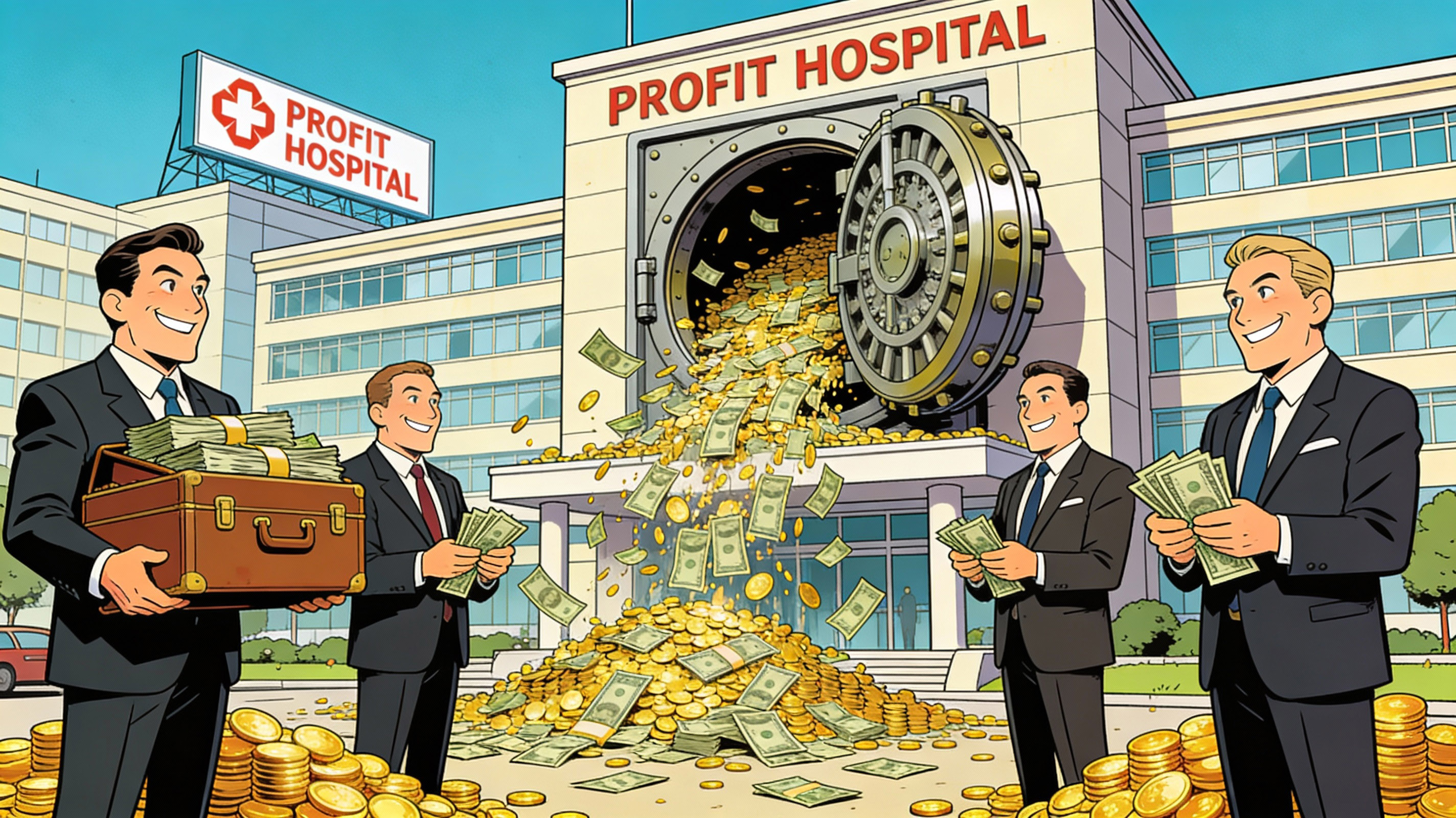
When you hear "Non-Profit Hospital," you imagine nuns, soup kitchens, and benevolence. You should be imagining Goldman Sachs with a stethoscope.
Here is the reality: The majority of American hospitals are "non-profits" (501(c)(3)). This status exempts them from federal, state, and local property taxes. In exchange, they are supposed to provide "community benefit" and charity care.
They do not.
Instead, they operate like ruthless private equity firms.
- The Tax Dodge: The value of their tax exemption is estimated at $28 billion annually. That is $28 billion that should be funding your schools and roads, which is instead funding their investment portfolios.
- The Hoard: Many large systems hold billions in cash reserves and investment funds. They act like hedge funds that occasionally perform surgery to justify their existence. Ascension Health, for example, ran a multi-billion dollar investment operation while cutting clinical staff.
- The Predatory Collection: Despite paying no taxes, they are often the most aggressive debt collectors. They sue low-income patients, garnish wages, and place liens on homes for bills that should have been written off as charity care.
A study by the Lown Institute found that 77% of non-profit hospitals spend less on charity care than the value of the tax breaks they receive. They are not giving back to the community; they are taking from it.
The Trap: We subsidize them to be charitable. They take the subsidy and use it to build monopolies and pay CEOs $10 million a year.
The Fix
The SAFEC+ Solution: The Free Ride Is Over ✅
SAFEC+ does not care about your tax status. It cares about your behavior.
1. The Luxury Spending Ban (Section 604) Under Section 604(c), federal capital grants are strictly prohibited from being used for "executive administration buildings, marketing assets, atriums, or aesthetic landscaping". We fund MRI machines and ICUs. We do not fund marble lobbies or waterfalls for the donors.
2. The CEO Cap (Section 501A) The government calculates "Allowable Costs" to determine payments. Section 501A(c)(2) explicitly excludes "excessive executive compensation" from this calculation. If a hospital wants to pay its CEO $15 million, they can do it with their own money—but the taxpayer will not reimburse a dime of it.
3. Global Budgets (Section 402) By moving rural and safety-net hospitals to Global Budgets, we decouple revenue from volume. The incentive to "churn and burn" patients to generate profit margins disappears. You get paid to treat the community, not to maximize billing codes.
4. Mandatory Safety Net (Section 601) Access to the Safety Net Care Fund comes with strings attached. You cannot take public money and then turn away the public. Section 602 mandates care for non-members (like tourists or undocumented immigrants) in emergencies, closing the loophole where "non-profits" dump unprofitable patients on county hospitals.
SAFEC+ restores the social contract: If you want public money, you serve the public interest.
The Critics
"We Need High Pay for Talent"
Hospital boards claim that if they don't pay the CEO $12 million, they cannot attract "top talent."
Managing a regional hospital monopoly is not inventing the iPhone. It is a utility. The head of the Social Security Administration runs a trillion-dollar agency for $200,000. The idea that hospital CEOs need NBA-level salaries to keep the lights on is a lie designed to justify looting the treasury.
"Hospitals Will Close"
Critics will argue that removing these tax advantages or restricting profits will cause hospitals to shut down.
Section 402(d) protects essential hospitals with Global Budgets. We guarantee their operating costs are covered. We just stop covering their excess profit. A hospital that closes because it can "only" break even was never a hospital; it was a business masquerading as one.
The Endowment Trap
Many hospitals rely on investment income from their reserves to offset operating losses. If we squeeze them too hard, they might dip into reserves until they are empty.
The Mitigation: This is why Section 604 provides direct capital grants for modernization. We replace the reliance on Wall Street gambling with steady, predictable infrastructure funding.