
The Trap
The Invisible Hand (In Your Pocket) 🔒
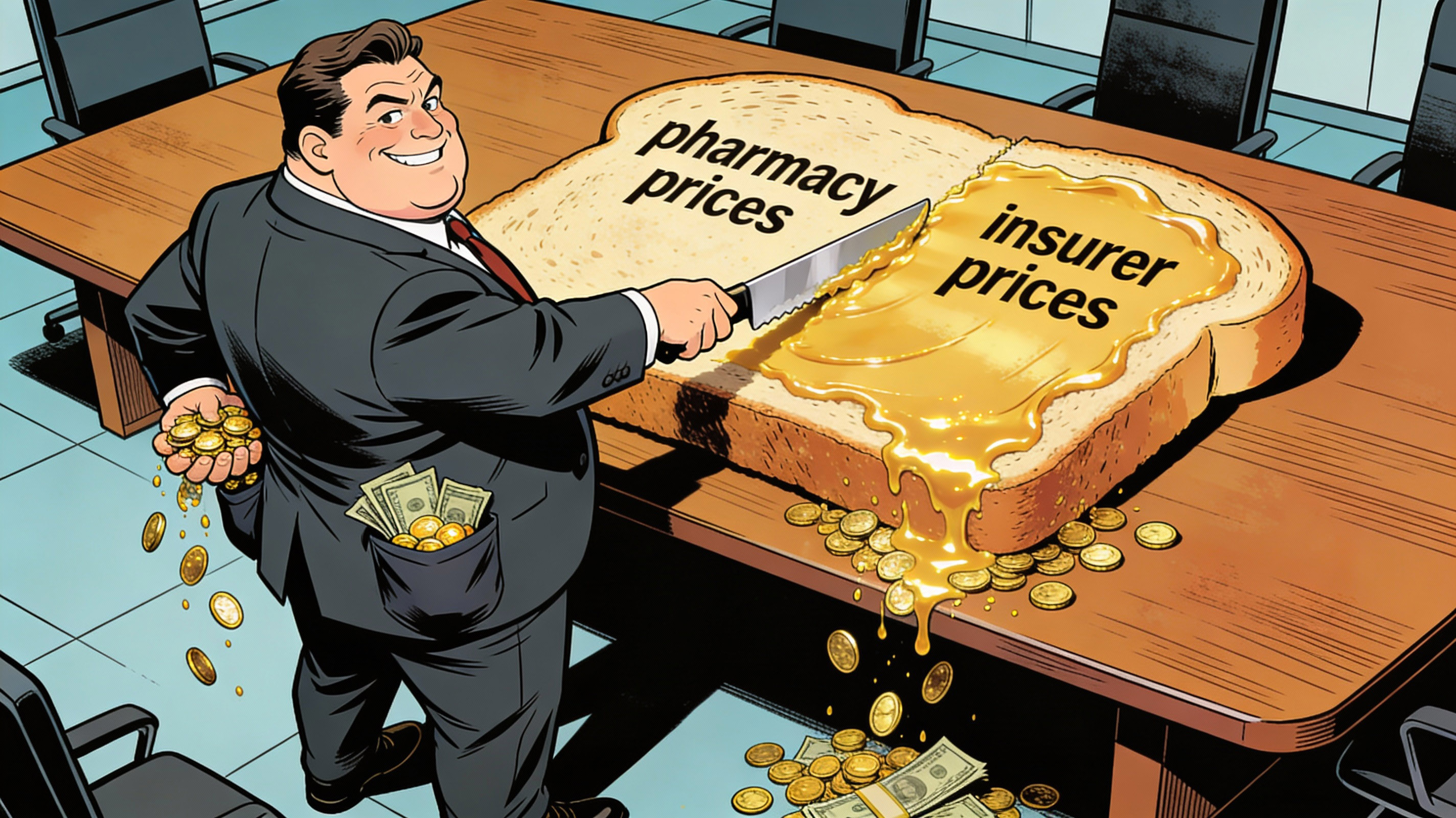
Imagine you send a friend to buy you a pizza. You give him $50. He goes to the shop, buys the pizza for $15, keeps the $35 change, and tells you, "Bro, pizza prices are crazy these days."
In the underworld of healthcare, that friend is called a Pharmacy Benefit Manager (PBM).
PBMs were originally hired to process paperwork. Today, they are the black hole of the pharmaceutical supply chain. They sit between the payer (your employer or insurer) and the seller (the pharmacy). Because they control the data, they can play a game called "Spread Pricing."
Here is the mechanic:
- The Clawback: The PBM tells your employer (or the taxpayer) that a generic heart medication costs $100. The employer pays the bill.
- The Squeeze: The PBM turns around and pays the local pharmacy $10 for dispensing that same drug.
- The Ghost: The PBM keeps the $90 difference. This is the "spread."
They did not manufacture the pill. They did not prescribe the pill. They did not dispense the pill. They simply moved a file from one server to another and charged a 900% markup for the privilege.
The Rebate Racket 🪙
It gets darker. PBMs also control which drugs are covered (the "formulary"). Drug companies want access to your veins, so they bribe the PBMs to get on the list. These bribes are politely called "rebates."
If a drug company raises its price from $200 to $400, they can offer the PBM a bigger rebate. The PBM loves high prices because their cut gets bigger. They actively exclude cheaper drugs because a $5 generic offers no room for a kickback.
The Trap: We have a system where the gatekeepers make more money when you get sicker and the cure gets more expensive.
The Fix
The SAFEC+ Solution: Sunlight and Sledgehammers ✅
We do not negotiate with the middleman. We fire him.
1. The National Formulary (Section 405) SAFEC+ establishes a single National Formulary. The list of covered drugs is determined by clinical efficacy, not by who paid the biggest kickback to a corporate intermediary. The government negotiates directly with the manufacturer.
2. Net Price Mandate (Section 405(b)) We switch to a "Negotiated Net Price" model. The Plan pays the actual price of the drug. Not the list price, not the sticker price, not the "Average Wholesale Price" (which is a made-up number). The price on the invoice is the price we pay. The spread drops to zero because there is no gap left to hide in.
3. The International Ceiling (Section 405(c)) To ensure the "Net Price" isn't gouging us, we cap it at the International Reference Price. If Germany and Japan pay $20 for insulin, we pay $20. We define this price net of all rebates and discounts, so manufacturers cannot hide secret deals overseas.
4. Audit and Destroy (Section 405(e)) Manufacturers must report their true net prices. If they lie, or if they try to hide kickbacks, they face civil monetary penalties. The "black box" of drug pricing is ripped open.
SAFEC+ treats PBMs like what they are: expensive overhead. We cut the overhead.
The Critics
"PBMs Save You Money"
The industry lobby (PCMA) spends millions claiming they "negotiate savings" for patients.
They negotiate savings for themselves. Study after study shows that PBMs often charge Medicaid programs far more than the acquisition cost of the drug. They are arsonists selling fire insurance. Under SAFEC+, the government's bulk purchasing power (Section 405) dwarfs anything a PBM can achieve, and the savings go to the Trust Fund, not a CEO's bonus.
"Restricted Access"
Critics will claim a National Formulary restricts choice compared to private plans.
Private plans already restrict choice based on profitability. They force you to "fail first" on cheap drugs before approving the one you need. SAFEC+’s formulary includes an exception process for medical necessity (Section 405(f)), ensuring access is based on biology, not the PBM's profit margin.
The Middleman Collapse
The PBM industry employs thousands of people who process claims and manage data. SAFEC+ automates much of this through the National Health Claims Data Platform (Section 801).
The Mitigation: This is efficient, but it is also a job killer for the "medical bureaucracy" sector. We must acknowledge that efficiency has a body count in the admin sector. However, we cannot justify keeping drug prices high just to employ people to count the money.