
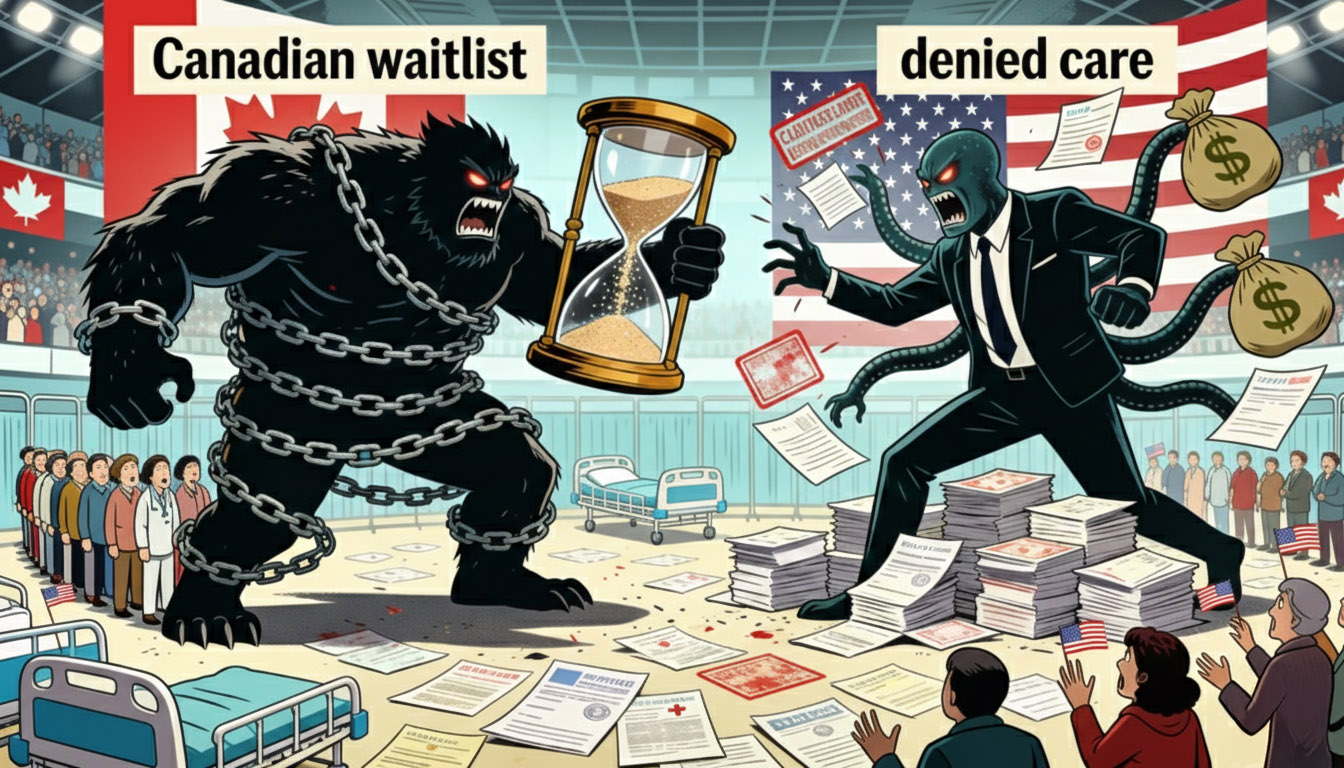
The Trap
The Wallet-List ⚠️
There is a favorite ghost story told by the defenders of the status quo. They whisper, "If we pass universal healthcare, you will have to wait in line like a Canadian." They conjure images of Soviet bread lines, where you stand in the snow for three hours to get an aspirin.
Here is the reality: You are already on a waitlist. You just don't see it because it is organized by bank account, not by medical need.
In America today, the "line" is invisible, but it is deadly efficient.
- The Deductible Line: You have a lump. You have insurance. But your deductible is $5,000. So you wait until next year to check it. That is a waitlist.
- The Network Line: You need a specialist. Your insurer says there are only three "in-network" neurologists in your state. The next appointment is in November. That is a waitlist.
- The Authorization Line: Your doctor orders an MRI. Your insurance company's AI denies it. You spend three weeks appealing. That is a waitlist.
The current system rations care based on wealth. If you have money, you cut the line. If you don't, you wait until the condition becomes an emergency, and then you wait in the ER hallway. This is not "freedom." It is financial triage.
The Fix
The SAFEC+ Solution: Medical Triage Supply Shock ✅
SAFEC+ trades financial rationing for medical rationing. That sounds scary, so let’s translate: The sickest people go first.
1. Triage, Not Net Worth Under Section 103, every legal resident is entitled to care. When you show up at the hospital, they ask "Where does it hurt?" not "What is your credit score?" If you have a brain tumor, you are seen immediately. If you have a sprained ankle, you might wait while they treat the brain tumor. That is how civilization is supposed to work.
2. The Supply Shock (Title V) Waitlists are a math problem: Too many patients, not enough doctors. The current system created this shortage on purpose (see "The Artificial Scarcity"). SAFEC+ fixes the math:
- Tuition Caps (Section 501): We cap medical school tuition at $15,000/year so new doctors aren't drowning in debt.
- Workforce Expansion (Section 504): We identify shortage areas and flood them with debt-free providers.
3. Global Budgets (Section 402(d)) We pay rural hospitals a Global Budget to stay open 24/7, regardless of patient volume. This keeps local ERs from closing, which stops the "healthcare desert" phenomenon that forces people to drive three hours (a physical waitlist) for basic care.
4. Supplemental Safety Valve (Section 105) If you want to buy your way out of the line for non-essential amenities (like a private room or faster elective surgery), Section 105 allows private supplemental insurance. We don't ban wealth; we just ban it from determining who survives.
The Critics
"Canadians Die Waiting"
Lobbyists love to cite cherry-picked horror stories from Canada or the UK.
The data shows that while elective wait times (e.g., knee replacement) can be longer in public systems, urgent care is often faster. In the US, we have the worst of both worlds: high costs AND long waits. A 2023 Commonwealth Fund survey found that Americans wait longer for primary care than people in most other wealthy nations—and we pay double for the privilege.
"The Demand Explosion"
When you make something free, people use more of it. Critics argue the system will crash under the weight of "unnecessary" doctor visits.
There will be a "pent-up demand" shock. Millions of people with untreated hernias and cataracts will finally show up. This is a feature, not a bug. It means we are finally treating the sick. The Phased Implementation (Section 1005) over 7 years is designed specifically to ramp up capacity before the floodgates fully open.
Elective Delays
We must be honest: For non-urgent, elective procedures, you might wait longer than you do now if you have a "Platinum" PPO plan.
The Mitigation: This is the trade-off. We accept a 4-week wait for a non-urgent knee scope so that a diabetic doesn't have to wait until their foot turns black to see a doctor. It is a moral calculation.